The Biometric Data Pipeline: From Body to App
To see how a physical event becomes a number on your phone, trace the pipeline below. Each row shows a stage of measurement, processing, or interpretation—and each transition is a place where error can enter or where the metric becomes an inference rather than a direct reading.
The transformation from physiological event to interpreted biometric metric
| Physiological Event | Sensor Action & Raw Signal | Signal Processing | Interpreted Metric |
|---|
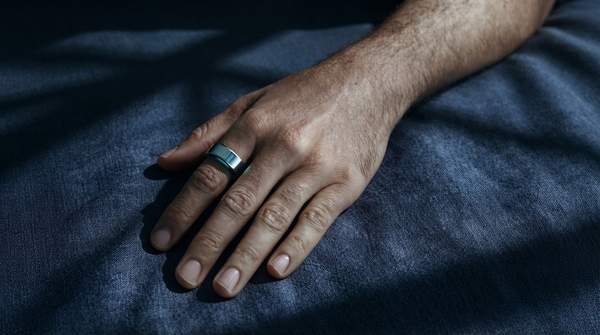
| Blood volume pulse: the heart's pumping causes rhythmic blood volume changes in capillaries, detectable at the finger's surface | LED emits light into skin; photodetector measures reflected light intensity, producing a raw PPG voltage waveform | Filtering removes motion artifacts and noise; AC component isolated from DC baseline | Heart rate (BPM) from peak counting; HRV (ms) from beat-to-beat time variation |
| Body movement and periods of rest | Accelerometer records motion data from the finger | Activity and stillness patterns classified across the day and night | Activity levels, step counts, wake-versus-sleep discrimination |
| Skin temperature variation reflecting circadian rhythm and recovery state | Temperature sensor tracks skin temperature relative to personal baseline | Trend analysis against individual baseline, often paired with HRV | Recovery and illness-warning signals |
| Combined physiological state across the night | All three sensors stream data simultaneously | Algorithmic fusion of heart rate, HRV, motion, and temperature data | Sleep stages (light, deep, REM)—an inference, not a direct measurement |
The critical insight is in the final row: sleep staging is not something any single sensor can observe. The PMC systematic review describes how one widely studied algorithm, the Oura Sleep Staging Algorithm, integrates accelerometer, heart rate, heart rate variability, and temperature data through machine learning, achieving 79% four-stage classification accuracy—approaching, but below, the roughly 83% agreement rate between human polysomnography technicians scoring the same records. The specific proprietary algorithms vary by manufacturer and are not publicly detailed, but the principle is consistent: distinct data streams are combined to classify physiological states.