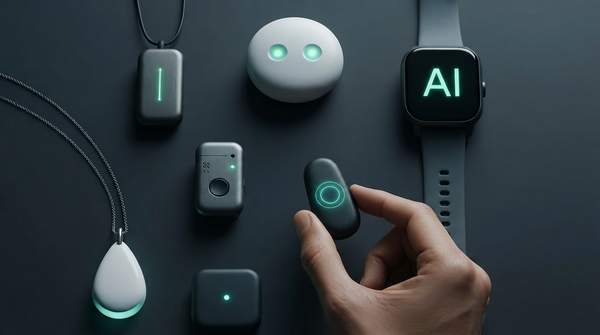
Dedicated AI hardware has split into three distinct philosophies: the Rabbit R1 puts a small screen and voice controls in a $200 pocket companion that operates your apps for you; the Humane AI Pin abandons screens entirely, projecting information onto your palm at $699 plus a $24 monthly fee; and Nothing's still-unnamed device, announced for a December 2026 ship date, will reportedly have "no new screen" at all. Each company is wagering on a different answer to the same question: if AI makes apps obsolete, what should the device that replaces them look like?
The Rise of Dedicated AI Hardware: A New Frontier
Smartphones have anchored personal technology for nearly two decades, but a wave of startups now argues that AI should live in dedicated hardware rather than inside another app. Reporting on the category has described these as portable AI-first devices that interact with users in natural language, deliberately moving away from screens and app-based operating systems. Prominent investors have treated the category as a serious wager on the future of computing rather than a gadget fad — OpenAI's Sam Altman, notably, is an investor in Humane.
The earliest attempts have not fared uniformly well: the Humane AI Pin drew criticism for practicality, latency and accuracy, while the Rabbit R1 launched to mixed reviews, with reviewers noting gaps between promised and delivered functionality. Into that unsettled landscape, Nothing — a company known for phones and audio — has now announced its own entry, adding a third, more productivity-focused philosophy to the field.
Rabbit R1: The Pocket-Sized AI Companion
The R1 is the most conventional of the three: a handheld orange square that Rabbit positioned as a "pocket companion that moves AI from words to action," in Engadget's Cherlynn Low's hands-on characterization. Its core idea is delegation. Rather than operating apps yourself, you sign into each service once through Rabbit's web portal, the Rabbit Hole, and then ask the device by voice to complete tasks — handing control to what the company calls its Large Action Model. Reviewers have praised its industrial design, and its working, reliable screen and easy-to-use controls, including a scroll wheel, made it more immediately approachable than its screenless rival.
The economics are simple: $199 or $200 depending on the report, and — unlike the AI Pin — an apparently pay-once model with no reported subscription fee for core functionality. Critics, though, have called out its subpar hardware and its reliance on future updates to meet launch expectations.
Humane AI Pin: The Wearable, Screenless Assistant
Humane made the most radical interface choice: no screen at all. The Pin is a $699 wearable that projects a laser-ink display onto the palm of your hand and handles everything else through voice commands. It can reportedly draft messages that sound like you from a simple spoken prompt and translate languages in real time. But the pricing structure is the industry's steepest — the device "won't work without" a monthly subscription, reported at $24 or $25 depending on the source, stacking a recurring cost on top of a $699 purchase. Reception was harsh. TechCrunch relayed that the Pin received "some truly scathing reviews," and reporting by Decrypt noted it was criticized specifically for impracticality, huge latency, and low accuracy. As a design statement, it is the purest expression of the screenless thesis; as a product, it launched undercooked.
Nothing's AI Device: The 'No New Screen' Philosophy
Nothing's entry is the newest and the least defined. The company, which has built a cult following around retro-inspired phones and audio gear, announced that its first AI-native hardware product begins shipping in December 2026. CEO Carl Pei has confirmed the device will have "no new screen" and, notably, that it cannot simply be replicated through a mobile application — a direct preemptive strike against the most common criticism of AI hardware.
Reporting by CNET's Katie Collins suggests the device will lean toward work rather than play: Pei has argued that AI, like computers before it, must prove itself in productivity and the workplace before it becomes genuinely useful in personal life. Beyond that, details remain preliminary, and its price and subscription model are unannounced. It is the least known quantity in the field, but the most explicit bet on AI hardware as a tool rather than a toy.
The Core Debate: Dedicated AI Hardware vs. Smartphones
Underneath all three products runs the same unresolved question: why buy a new device at all? As Decrypt's Jose Antonio Lanz reported, smartphones with newer processors already offer AI-powered features, and "the best way to carry AI with you might very well be the ubiquitous smartphone rather than a specialized device." The counter-case is that these devices aim to offer AI without requiring users to open an app at all — a qualitatively different interaction model. The first generation's record feeds the skepticism: the R1 turned out to be mostly powered by cloud scripts, and the Pin's launch problems are well documented.
Mark Kelly, writing on his Substack, drew a comparison to the original iPhone's launch gaps between promise and delivery — but also noted that buyers eventually asked why older phones couldn't do what the iPhone did. Whether that pattern repeats is precisely what the Nothing launch will help reveal.
AI Hardware Showdown: A Comparative Overview
Juxtaposing what is actually known about each device clarifies the trade-off each company has accepted — and reveals three genuinely different bets rather than three versions of the same product.
| Device | Announced Price | Subscription Model | Primary Interface | Form Factor |
|---|---|---|---|---|
| Rabbit R1 | $199–$200 (one-time purchase) | No subscription reported for core functions | Small screen, scroll wheel, voice; controls apps via the Rabbit Hole portal | Compact, pocket-sized handheld |
| Humane AI Pin | $699 | $24–$25 monthly subscription; the device won't work without it | Voice commands and a laser display projected onto the palm | Wearable, screenless |
| Nothing AI device | Not announced | Not announced | "No new screen," per CEO Carl Pei; not replicable as a mobile app | Unannounced; positioned as a productivity tool |
The comparison yields a clear verdict on each bet. The R1 is a screen-based app controller: it keeps familiar hardware conventions and asks you to trust it with your logins. The Pin is a screenless wearable assistant: the boldest interface experiment, at the highest cost of ownership — roughly $1,000 in the first year with the subscription. Nothing's device is a screenless productivity tool: the least specified, but the only one explicitly designed to answer the "why not just an app?" objection, and its pricing will determine whether the productivity bet is also the affordable one.
Deciding on Dedicated AI: A Forward Look
Readers should evaluate dedicated AI hardware based on their comfort with new interaction paradigms — screen-based delegation, palm projection, or an interface that does not yet exist in any shipping product — and their willingness to adopt a device that may or may not replace smartphone functions, in a market still very much in its first generation. The measurable indicator to watch: the market reception and sustained utility of these devices, particularly how well they integrate into daily routines without requiring a smartphone, will indicate their long-term viability. Nothing's December 2026 ship date is the next concrete milestone — its price, its interface, and whether it can do what the Pin and R1 could not will tell us whether the third bet breaks the pattern.
Sources
- Startups Are Racing to Create the iPhone of AI — TIME
- Rabbit R1 hands-on: Already more fun and accessible than the Humane AI Pin - Engadget
- Nothing to launch its first AI-native hardware product next month — mint
- The Future of AI Hardware: Why Tech Companies are Building Devices Beyond Smartphones — Artificial Intelligence News & Cryptocurrency News: Latest Trends | Analytics Insight
- Watch: Between Rabbit’s R1 vs Humane’s Ai Pin, which had the best launch? — TechCrunch
- Rabbit r1 vs Humane AI Pin: What’s the difference? — Trusted Reviews
- The Rabbit R1: Early Impressions of an Undercooked AI Device — Markdkelly
- This iPhone Challenger Could Transform Smartphones by Trading Apps for AI - Decrypt
- Cult Phone-Maker Nothing’s Mystery Screenless AI Device Is Coming Next Month - CNET