Southeast Asian e-commerce is entering a more operationally demanding phase. The region’s online economy continues to expand, but growth increasingly depends on how effectively businesses manage fulfilment, inventory, margins, and customer expectations. Momentum Works reports that Southeast Asian e-commerce platform GMV reached US$157.6 billion in 2025, with fulfilment and operational control becoming increasingly important as competition intensifies.
For businesses navigating this environment, an order management system can provide more than a convenient way to view purchases. It can become an important part of the operational infrastructure connecting orders with inventory, fulfilment, warehousing, and distribution. IDEALONE is positioned around this need, offering an order management and logistics system designed for Southeast Asian e-commerce, with distribution and warehousing solutions forming part of its broader operational focus.
The Growing Complexity Behind a Simple Online Order
From a customer's perspective, placing an e-commerce order is straightforward. A product is selected, payment is made, and the customer waits for delivery.
Behind that transaction, however, several processes may need to happen correctly. The business needs to identify the order source, confirm product availability, allocate stock, prepare the item for fulfilment, coordinate warehouse activity, arrange distribution, and maintain accurate order information throughout the process.
That complexity increases when a business sells through several channels.
A merchant might have its own online store while also selling through marketplaces, social commerce channels, physical locations, or other digital sales platforms. Each channel can generate orders that need to be processed consistently. Managing those activities separately can create unnecessary administrative work and increase the possibility of mismatched information.
This is one reason order management has become an important consideration for growing e-commerce businesses.
Why Centralized Order Information Matters
An order management system, or OMS, is designed to help businesses organize information and workflows around customer orders.
The value is not simply having another dashboard. The larger objective is to create a more coordinated operational process in which information about an order can move through the business without requiring employees to repeatedly reconcile disconnected systems.
For example, consider a customer ordering a product that is available in a warehouse. The business needs to know that the order has been received, that stock can be allocated, and that fulfilment can proceed. If the same product is being sold elsewhere, the inventory position also needs to remain accurate.
When information is fragmented, teams can spend considerable time checking spreadsheets, messages, marketplace accounts, warehouse records, and other systems. Industry analysis of Southeast Asian e-commerce identifies inventory mismatches, fragmented systems, and limited order visibility as recurring challenges for growing businesses.
Centralized order management can help businesses approach those processes more systematically.
Inventory and Orders Are Closely Connected
Order management cannot be separated completely from inventory management.
A customer cannot receive an item that the business does not have available, and an e-commerce business cannot confidently promise stock availability if inventory information is outdated.
This becomes more complicated as the number of sales channels increases. A product may sell through several platforms within a short period, creating multiple demands on the same inventory pool.
Without coordinated information, businesses can encounter situations where one channel shows stock that has already been committed elsewhere. The result can be overselling, cancelled orders, delayed fulfilment, or additional manual intervention.
An integrated approach helps businesses think about orders and inventory as connected operational activities rather than isolated administrative tasks.
That connection becomes particularly relevant when a business operates across several warehouses or markets. Inventory may be distributed geographically, while orders can originate from customers in different locations.
Warehousing Is Part of the Order Journey
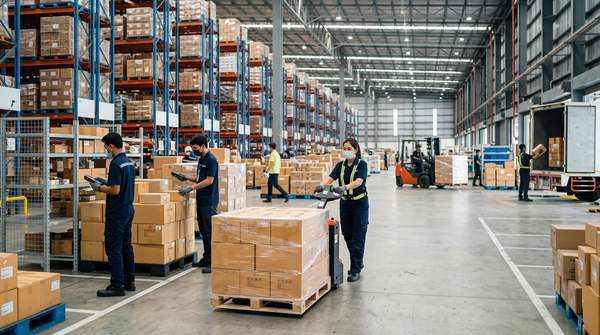
The warehouse is not simply a place where products sit until they are sold.
Once an order has been received, warehouse teams may need to identify the correct item, retrieve it, prepare it for shipment, and hand it into the appropriate distribution process. If warehouse information and order information are disconnected, the business can lose visibility at exactly the point where execution begins.
Southeast Asian e-commerce creates additional challenges because the region does not operate as one uniform logistics market. Geography, infrastructure, customer preferences, delivery networks, and market conditions vary significantly between countries. J&T Express, for example, has noted that fulfilment approaches suitable for Singapore may not necessarily apply in Indonesia, the Philippines, Thailand, Malaysia, or Vietnam.
For businesses serving multiple markets, an operational system therefore needs to support organization across different parts of the fulfilment journey.
The Importance of Visibility
Visibility is one of the most practical reasons businesses consider order management technology.
When an order is moving through several operational stages, employees need to know what has happened and what needs to happen next. Customers also increasingly expect information about their purchases.
Research from McKinsey has highlighted delivery delays, slow service, poor tracking, and damaged packages among common e-commerce logistics pain points in Southeast Asia.
While an order management system cannot eliminate every logistical challenge, better information can help businesses manage their internal processes more systematically.
Visibility can also support decision-making. When operational information is organized, businesses have a stronger foundation for identifying recurring issues, reviewing fulfilment activity, and determining where processes may need improvement.
Why Regional Context Matters
A system designed with Southeast Asian e-commerce in mind needs to recognize that regional operations can be more complicated than simply shipping products from one warehouse to customers.
A business expanding across countries may encounter different delivery environments, customer expectations, marketplace ecosystems, and operational requirements. Cross-border logistics can also introduce additional customs and compliance considerations.
That means technology should support the way the business actually operates rather than forcing every market into an identical model.
For IDEALONE, this regional orientation is an important part of its positioning. Rather than treating order management as an isolated software function, its proposition connects order management with logistics, distribution, and warehousing for Southeast Asian e-commerce businesses.
When Should a Business Consider an Order Management System?
There is no universal order volume at which every business suddenly needs an OMS.
Instead, businesses can look for operational warning signs.
If employees regularly reconcile orders manually, inventory numbers frequently need checking, multiple sales channels are becoming difficult to coordinate, or warehouse and distribution activities are increasingly disconnected, the business may have outgrown its existing processes.
Growth itself can expose weaknesses that were not visible when order volumes were smaller.
A process that works for dozens of orders may become difficult to maintain when the same team is handling hundreds or thousands of transactions across multiple channels. The challenge is not simply processing more orders. It is maintaining consistency while the number of variables increases.
Building a More Organized E-Commerce Operation
An order management system should ultimately serve a business objective: making complex operations easier to organize.
That means considering the entire order journey rather than looking at orders as individual transactions. Where does the order originate? Is inventory available? Where should it be fulfilled? What happens in the warehouse? How does distribution begin? What information needs to remain visible along the way?
These questions become increasingly important as Southeast Asian e-commerce businesses expand.
IDEALONE's positioning around order management, logistics, distribution, and warehousing reflects this broader operational perspective. For businesses evaluating technology in this category, the most useful approach is to look beyond the promise of another software platform and assess whether the system can support the real processes that sit behind every online sale.
In a competitive e-commerce environment, better operational organization can be just as important as generating another order. The customer may only see a checkout page, but behind that transaction is an entire chain of decisions and activities. A capable order management approach helps businesses bring those moving parts into a more coherent operational framework.