Physical AI—artificial intelligence that acts on the physical world rather than just on data—has moved from concept to factory floor. In manufacturing and logistics, intelligent robots now perform adaptive welding, force-sensitive insertion, and warehouse inspection, tasks that traditional automation could not reach because they were too variable or too dexterous for fixed machinery. The World Economic Forum, in a 2025 report prepared with BCG, frames these systems not as single machines but as a five-layer technology stack, from mechanical hardware up to user-facing application interfaces. Understanding that stack, and the application categories it enables, is the clearest way for industrial leaders to see what is actually changing in their operations—and in the jobs around them.
What is Physical AI?
The distinction matters. Digital AI—generative, predictive, and agentic systems—works on information. Physical AI works on things: it senses, decides, and acts in the physical world. As Global X ETFs' research puts it, robots are evolving "from a narrow factory tool into a broader platform for physical automation," a shift the firm links to measurable productivity gains, with a 1% increase in industrial robot density associated with a 0.8% increase in labor productivity.
That framing also explains why the moment is different from earlier automation waves. Trossen Robotics, writing on the market for automating manual labor, describes the opportunity as the "repetitive, dexterous physical work businesses still do by hand because it was too variable, too fragmented, or too expensive for traditional automation to reach." Physical AI, in that account, is beginning to make such work economically automatable for the first time. The Bipartisan Policy Center, which studied physical AI deployments in logistics, notes that because manufacturing and logistics have deployed these systems for several years, more robust research exists on their real-world impact than on digital AI's labor effects.
The Five-Layer Physical AI Technology Stack
The World Economic Forum's report deconstructs a physical AI system into five distinct layers, each with a specific function. Reading the stack from the bottom up shows how raw machinery becomes an adaptable, autonomous workforce:
| Layer | Function | What it enables |
|---|---|---|
| Robotic hardware | Mechanical base: actuators, controllers, and sensors or vision systems that let the robot act, sense, and perceive. | The physical foundation of the system—everything above it operates through this layer. |
| Edge hardware | On-device processors for real-time AI inference and sensor fusion. | Autonomous decisions with minimal latency and without cloud reliance, enabling immediate responses at the point of action. |
| Operating system | Backbone for hardware abstraction, process coordination, and component communication; manages task scheduling and integrates frameworks such as ROS. | Standardization and interoperability across components—the fundamental control and communication framework. |
| Simulation/training | Virtual environments, tools, and data platforms using synthetic data generation, high-fidelity simulators, and digital twins. | Accurate "sim-to-real" transfer, so robot behaviors are tested and refined virtually before deployment—safe, efficient development. |
| Application interfaces | APIs, connectors, and intuitive human-machine interfaces for monitoring and control. | Human interaction and task customization—how end users define and manage what the system does. |
The stack explains why modern robots behave less like programmed fixtures and more like trainable workers. Edge hardware frees them from constant cloud connectivity; simulation layers let engineers rehearse behaviors in digital twins; and application interfaces let non-specialists supervise and redirect them. Each layer is a distinct procurement and design decision, which is why the report treats the stack—rather than any single robot—as the unit of analysis.
Key Applications in Manufacturing and Logistics
The World Economic Forum's report sorts current high-impact applications into two categories. The first is direct manufacturing: physical AI applied to the production process itself. The report cites adaptive welding, force-sensitive insertion, and cable routing as examples of "the new frontier"—tasks demanding real-time perception and fine force control that rigid, pre-programmed automation could not handle.
The second category is indirect manufacturing: physical AI supporting the production line rather than working on the product. Here the report points to warehouse logistics and inspection routines, often delivered through mobile robots or hybrid embodiments that combine mobility with manipulation. These systems optimize material flow and quality control around the core process.
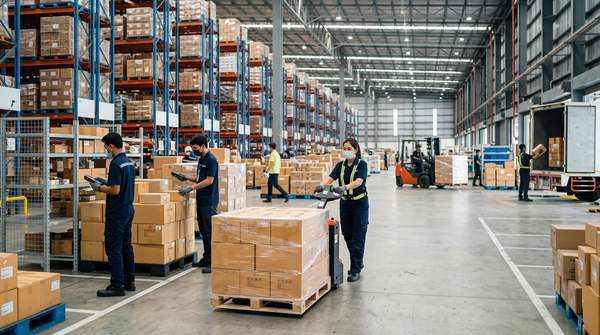
The Bipartisan Policy Center's fieldwork at Amazon's SHV1 fulfillment center grounds the logistics side of this picture, identifying three distinct effects of physical AI on work in a deployed facility. The common thread across both categories is adaptability: the value of these systems lies in handling variation—irregular parts, changing layouts, unpredictable demand—rather than in raw repetition speed alone.
Impact on the Industrial Workforce
The labor question is where evidence is most nuanced. The Bipartisan Policy Center's research found that physical AI adoption in fulfillment centers "expands the scope of some roles and creates new types of work"—an effect distinct from simple job elimination. Trossen Robotics makes the complementary argument: the same techniques that make robots trainable can make people retrainable, through AI-generated documentation, simulations, troubleshooting guides, role-specific training, and personalized learning paths for workers moving "from repetitive execution into higher-leverage technical and operational roles." The company is explicit that this "does not happen automatically. It has to be built intentionally."
For scale, Trossen cites the World Economic Forum's Future of Jobs Report 2025, which projects 170 million new roles and 92 million displaced roles by 2030—a net increase of 78 million jobs—while emphasizing urgent workforce upskilling. The pattern is dual: some repetitive physical tasks shift to machines, while new roles in robot operation, training, maintenance, and integration emerge alongside them. The Bipartisan Policy Center's framing of "expanded roles" suggests that for many existing workers, the change is as much about the content of the job as about whether the job exists.
Navigating the Physical AI Transformation
Industrial leaders and workers should focus on understanding the specific applications of physical AI within their sectors and invest in developing new technical and operational skills to adapt to evolving roles. In practice, that means mapping which tasks in a facility fall into the automatable categories—dexterous, variable, previously unautomatable work—and which human roles those systems will expand rather than erase.
The measurable indicator to watch is increased adoption rates of physical AI systems in manufacturing and logistics, coupled with a growing demand for specialized roles such as robot operators, trainers, and integration specialists. Global X ETFs' research points to 2026 as a potentially pivotal year, driven by improving technology, falling costs, and stronger policy and capital support for domestic industrial capacity. For operators, the near-term milestones are concrete: which processes move from manual to machine, and which new technical roles appear on the floor to run them.
Sources
- Reports
- Robotics: AI Moves into the Physical Economy — Global X ETFs
- The Trillion-Dollar Market Hidden in Unautomated Human Labor — Trossen Robotics
- Moving Parts: How Physical AI Is Reshaping the Logistics Sector — Bipartisan Policy Center